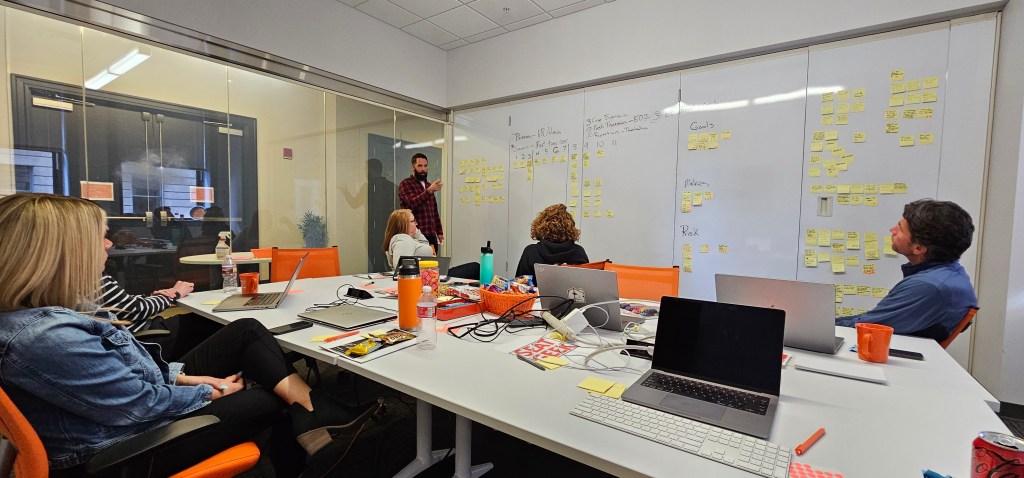
How I’ve Used Design Sprints to Validate Big Ideas and Deliver Impactful Results
Why Design Sprints?
Design Sprints are among the most effective tools I’ve used to solve complex problems, align teams, and validate ideas quickly. I was introduced to the process through Jake Knapp’s book Sprint: How to Solve Big Problems and Test New Ideas in Just Five Days, which showcases how top companies use this framework to drive innovation.
Shortly after reading the book, my company’s Chief Product and Technology Officer gave us a daunting challenge: identify a way to generate $5M in additional recurring revenue for the following year. I spent days interviewing team members and brainstorming in a war room with the Vice President of Product Management, Vice President of Engineering, and Director of Design and Innovation. But no idea seemed to stick.
That’s when I pitched the idea of running a Design Sprint.
If you’re unfamiliar, a Design Sprint is a collaborative, structured workshop in which stakeholders work together to define, prototype, and test a solution to a big problem—all in just five days. The results can be transformative. However, I quickly learned that getting stakeholders to commit to a full five-day sprint was a challenge in itself.
So, I adapted the process. By condensing the timeline into four days—with two focused on collaboration and two on prototyping and testing—I created a framework that balanced time constraints with the sprint’s impact. This approach delivered results and became my go-to method for solving big challenges.
 Brice Gould Design
Leave a comment